Why do some people end up loving what they do, while so many others fail and lead lives of mediocrity and boredom?
In almost every movie, they are showing to go behind dream, passion even if possible leave your parents, partner,home and pursue your dream, passion and people are getting manipulated by these so called propaganda. Never leave your responsibility, duty do whatever possible in your hand and Never leave your family for so called dream because majority fall into the trap if you have no proper strategy and plan. The people who are successful in any field, they don’t blame circumstances or others. I have read a lot of books on it and talked to people about it and almost everyone suggest the same advice. Everyone offers the same thing—forget about money and follow your passions, regardless of your education, background, or level of enthusiasm for your work but Cal Newport has a different perspective(pov).
Four Rules
The book is structured around four rules that guide you toward work you love.
Rule #1: Don’t Follow Your Passion
The “passion hypothesis” is flawed. Steve Jobs speech at Stanford of June, 2005 where he gave life lesson about a third of the way into the address:
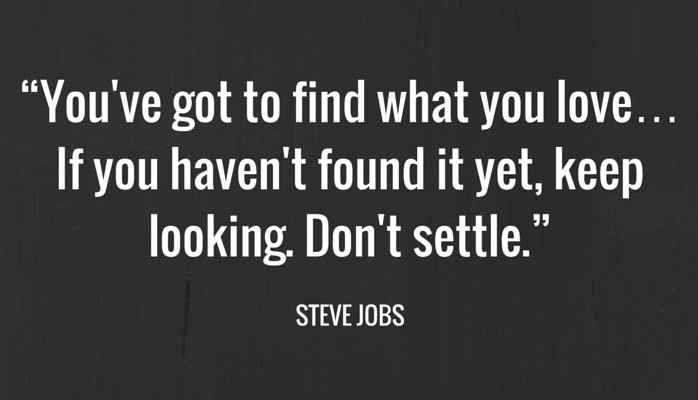
You’ve got to find what you love.. [T]he only way to do great work is to love what you do. If you haven’t found it yet, keep looking, and don’t settle.
but if we look into the life of Steve Jobs and the founding of Apple computer. Jobs did not follow his own advice. While his friend and Apple’s co-founder, Steve Wozniak, was passionate about computers and electronics, Jobs was far more interested in Eastern spirituality when he was young. When Jobs initially helped out Wozniak with circuit boards, it was purely to make a buck. Although Jobs probably developed a passion for his work eventually, he certainly did not find a job that matched one of his pre-existing passion. It tells that at least for Jobs, “follow your passion” was not particularly useful advice.
The Passion Hypothesis:
“‘Follow your passion’ is dangerous advice.” for two main reasons:
For most people, passion for work is rare and specific (e.g., a lucky few are born passionate about music or sports).
This is the “passion trap.” It convinces people that Somewhere there’s a dream “right” job waiting for you, and if you find it, you’ll realize that this is the work they were meant to do but the problem arise when you’ll fail to find the certainty, bad things follow, such as anxiety, chronic job-hopping as people constantly ask, “Is this job my true passion?” and crippling self-doubt.
Life is short so, don’t spend time on useless things. we often hear these advices and a lot of people will like it. “do what you love, and the money will follow” has become the de facto motto of the career-advice field.
How do we find work that we’ll eventually love?
Like Steve Jobs, should we resist settling into one rigid career and instead try lots of small schemes, waiting for one to take off? does it matter what general field we explore? how do we know when to stick with a project or when to move on?
How to “figure out what you want” and “know what you’ll be good at.”
In the movies there’s this idea that you should just go for your dream.
But Things happen in stages.
Al Merrick, the founder of Channel Island Surfboards, tells “People are in a rush to start their lives, and it’s sad. I didn’t go out with the idea of making a big empire,” he explains. “I set goals for myself at being the best I could be at what[ever] I did.”
Compelling careers often have complex origins that reject the simple idea that all you have to do is follow your passion.
Amy Wrzesniewski, a professor of organizational behavior at Yale University published paper in the Journal of Research in Personality where she explores the distinction between a job, a career, and a calling. A job is a way to pay bills, a career is a path toward increasingly better work, and a calling is work that’s an important part of your life and a vital part of your identity.
Daniel Pink, author of Drive, on TED talk, titled “On the Surprising Science of Motivation,” says “If you look at the science, there is a mismatch between what science knows and what business does.” When Pink talks about “what science knows,” he’s referring, for the most part, to a forty-year-old theoretical framework known as Self-Determination Theory (SDT).
SDT tells us that motivation, in the workplace or elsewhere, requires that you fulfill three basic psychological needs — factors described as the “nutriments” required to feel intrinsically motivated for your work:
Autonomy – the feeling that you have control over your day and that your actions are important
Competence – the feeling that you are good at what you do
Relatedness – the feeling of connection to other people
By 2000, the phrases “follow your passion” was showing up in print three times more often than in the 70’s and 80’s.
Rule #2: Be So Good They Can’t Ignore You (The Importance of Career Capital)

This is the core of the book. To get great work, you need something rare and valuable skills to offer in return. Newport calls this “career capital.”
What it is: Rare and valuable skills you possess.
How you get it: By adopting the “craftsman mindset,” not the “passion mindset.” the craftsman mindset is the foundation for creating work you love.
Passion Mindset: Focuses on what the world can offer you (fulfillment, meaning, fun). It’s self-centered.
Craftsman Mindset: Focuses on what you can offer the world (becoming excellent at your craft). It’s output-centered.
You must relentlessly focus on improving your skills and becoming “so good they can’t ignore you.” This accumulation of career capital is what gives you leverage to find great work.
Traits that define Great Work
Creativity: Pushing the boundaries and getting reward in the process.
Impact: From the Apple II to the iPhone, Steve Jobs has changed the way we live our lives in the digital age.
Control: No one tells you when to wake up, what to wear. You are not expected in an office from 9 to 5.
To Understand the science of how people get good at something, then check chess. It provides a clear definition of ability: your ranking. The current standard ranking system is the Elo system used by the world chess federation. This system gives player a score starting at zero that increases as they get better. If you do better than expected, it goes up, and if you do worse, it goes down. In 1990, Garry Kasparov became the first player to reach ever 2800. The highest Elo rating ever achieved by a human player is 2882, by Magnus Carlsen in May 2014. Magnus Carlsen was trained by Garry Kasparov from 2009 to 2010 and paid over $700,000 a year.
Malcolm Gladwell’s bestselling 2008 book, Outliers. He summarized it:
The 10,000-Hour Rule
The idea that excellence at performing a complex task requires a critical minimum level of practice surfaces again and again in studies of expertise. In fact, researchers have settled on what they believe is the magic number for true expertise: ten thousand hours[emphasis mine].
In Outliers, Gladwell pointed to this rule as evidence that great accomplishment is not about natural talent, but instead about being in the right place at the right time to accumulate such as massive amount of practice. They asked not just how long people worked, but also what type of work they did. They studied players who had spent roughly the same amount of time — around 10,000 hours — playing chess. Some of these players had became grand masters while others remained at an intermediate level. Both groups had practiced the same amount of time, so the real difference in their ability must depend on how they used these hours.
However, “if you just show up and work hard, you’ll soon hit a performance plateau beyond which you fail to get any better.” If you figure out to break the plateau and successfully integrate delibrate practice into your own life,so, you should approach your work with a dedication to systematically getting better deliberate practice.
Deliberate practice - To become so good they can’t ignore you, that requires you to come outside of your comfort zone.

The 5 traits of Craftsman:
Decide What Capital Market You’re In:
Capital Market – the market you are trying to acquire career capital in a field, there are two types of these market:
Winner-Take-All Market – a market with “only one type of career capital available and lots of different people competing for it.” It more focused on ability.
Auction Market – a less structured market with “many different types of career capital, and each person might generate a unique collection.” It focused on variety of other types of relevant skills.
Identify Your Capital Type:
Winner-Take-All Market: You need to master the one type of capital or skill that matters.
Auction Market: There is flexibility in the type of capital that you can build. You can create different combinations of skills to emphasize your rareness.
Seek Open Gates, which are the few “opportunities to build capital that are already open to you,” which get more career capital at a faster rate.
Define “Good”: Geoff colvin author of delibrate practice, put it this way in an article that appeared in Fotune: “Delibrate practice requires good goals.”
Stretch and Destroy: Delibrate practice is often the opposite of enjoyable. Delibrate practice is above all an effort of focus and concentration.
Be Patient: To apply delibrate practice to your working life is to adopt this style of diligence.
Rule #3: Turn Down a Promotion (The Control Trap)
Control over what you do, and how you do it, is incredibly important you can acquire when creating work you love.
Once you have career capital, you can trade it for great traits in your work, like creativity, impact, and control (the most important one, according to Newport).

Control – the importance of having power in what you do and how you do it
In his book Drive, Daniel Pink discusses how control has resulted in an overall better life in terms of better results, performance, productivity, and happiness. Within the workplace, the power of control is embodied in a radical new philosophy called ROWE:
Results-Only Work Environment (ROWE) – the corporate philosophy that shows the power of control by emphasizing that all that matters is your results. “No results, no job: It’s that simple,” as ROWE supporters like to say.
“Giving people more control over what they do and how they do it increases their happiness, engagement, and sense of fulfillment.”
The First Control Trap
It warns that it’s dangerous to pursue more control in your working life before you have career capital to offer in exchange. Control is seductive.
The First Control Trap – “control that is acquired without career capital is not sustainable”
If you embrace control without enough career capital, you will probably end up like “enjoying all the autonomy you can handle but unable to afford your next meal.”
The Second Control Trap
It warns that once you have enough career capital to acquire more control in your working life, you have became valuable enough to your employer that they will fight your efforts to gain more autonomy.
When no one cares about your working life, you probably don’t have enough career capital to do exciting work. Yet, when you do have the capital required to gain true control, you become prey to the Second Control Trap:
The Second Control Trap – “the point when you acquire enough career capital to acquire meaningful control over your working life, that’s exactly when you’ve become valuable enough to your current employer that they will try to prevent you from making the change”
When you acquire more control in your work, it benefits you but likely has no direct benefit to your employer. Your employer will oppose your attempts to take control and might persuade you to put your money back into your job. You might be rewarded with more responsibility, status, and a larger income rather than more control.
Avoiding The Control Traps
In 2010 TED talk on creativity and leadership, Derek Sivers, says “A leader needs the guts to stand alone and look ridiculous.” He has a simple principle: “Do what people are willing to pay for,” which is named, The Law of Financial Viability:
The Law of Financial Viability – It suggests that when deciding whether to follow an appealing pursuit that will introduce more control into your work life, seek evidence of whether people are willing to pay for it:
If so, continue.
If not, move on.
Rule #4: The Power of Mission (Think Small, Act Big)
A compelling mission (a unifying goal for your career) is key to finding passion. But you can’t just pick a mission out of thin air.
How do you make mission a reality in your working life?
If your goal is to love what you do, you must first build up “career capital” by mastering rare and valuable skills, and then cash in this capital for the traits that define great work.
Missions Require Capital

It argue that a mission chosen before you have relevant career capital is not likely to be sustainable.
In 2010, Steven Johnson’s wrote a book, Where Good Ideas Come From, which states that the innovative ideas are almost always discovered in the Adjacent Possible:
Adjacent Possible – a term borrowed from the complex-system biologist Stuart Kauffman, who uses it to describe the spontaneous formation of complex chemical structures from simpler structures. Johnson adopted the term and shifted it from complex chemicals to cultural and scientific innovations.
“A good career mission is similar to a scientific breakthrough—it’s an innovation waiting to be discovered in the adjacent possible of your field.” You must identify a mission for your working life, therefore, you must first get to the cutting edge — the only place where your mission will become visible.
Missions Require Little Bets

It argue that great missions are transformed into great successes as the result of using small and achievable projects — little bets — to explore the concrete possibilities surrounding a compelling idea. After identifying a mission, use the following strategy from venture capitalist Peter Sim’s 2011 book, Little Bets to succeed in your mission:
If you don’t have a trusted strategy for making this leap from idea to execution, then like me and so many others, you’ll probably avoid leap altogether.
Little Bets – short and attainable tasks to explore creative strategies to turn a complicated mission idea into concrete successful endeavors.
Missions Require Marketing

It argue that great missions are transformed into great successes as the result of finding projects that satisfy the law of remarkability, which requires than an idea inspires people to remark about it, and is launched in a venue where such remarking is made easy.
In his 2002 book , Purple Cow, Seth Godin says that “You’re either remarkable or invisible.” The world is full of boring stuff — brown cows — which is why so few people pay attention .. A purple cow... now that would stand out. “Remarkable marketing is the art of building things worth noticing.” You can adopt the mindset of a marketer using the strategy of the Law of Remarkability:
The Law of Remarkability – for a mission-driven project to succeed, it should be remarkable in two different ways:
it must compel people who encounter it to remark about it to others.
it must be launched in a venue that supports such remarking.
The Bhagavad Gita, Chapter 4, Verse 17 states:
“Karmano hyapi boddhavyam boddhavyam cha vikarmanaha |
akarmanashcha boddhavyam gahano karmano gatihi”. ||
The nature of karma(action) is very difficult to know. Verily, in order to understand fully the nature of proper action, one has also to understand the nature of contrary(wrong) action and the nature of inaction.
Summary
In essence, “So Good They Can’t Ignore You” says become so rare that you create your own luck and your work becomes impossible to ignore.
Enjoy and Happy Reading!
Thanks for reading this article.